
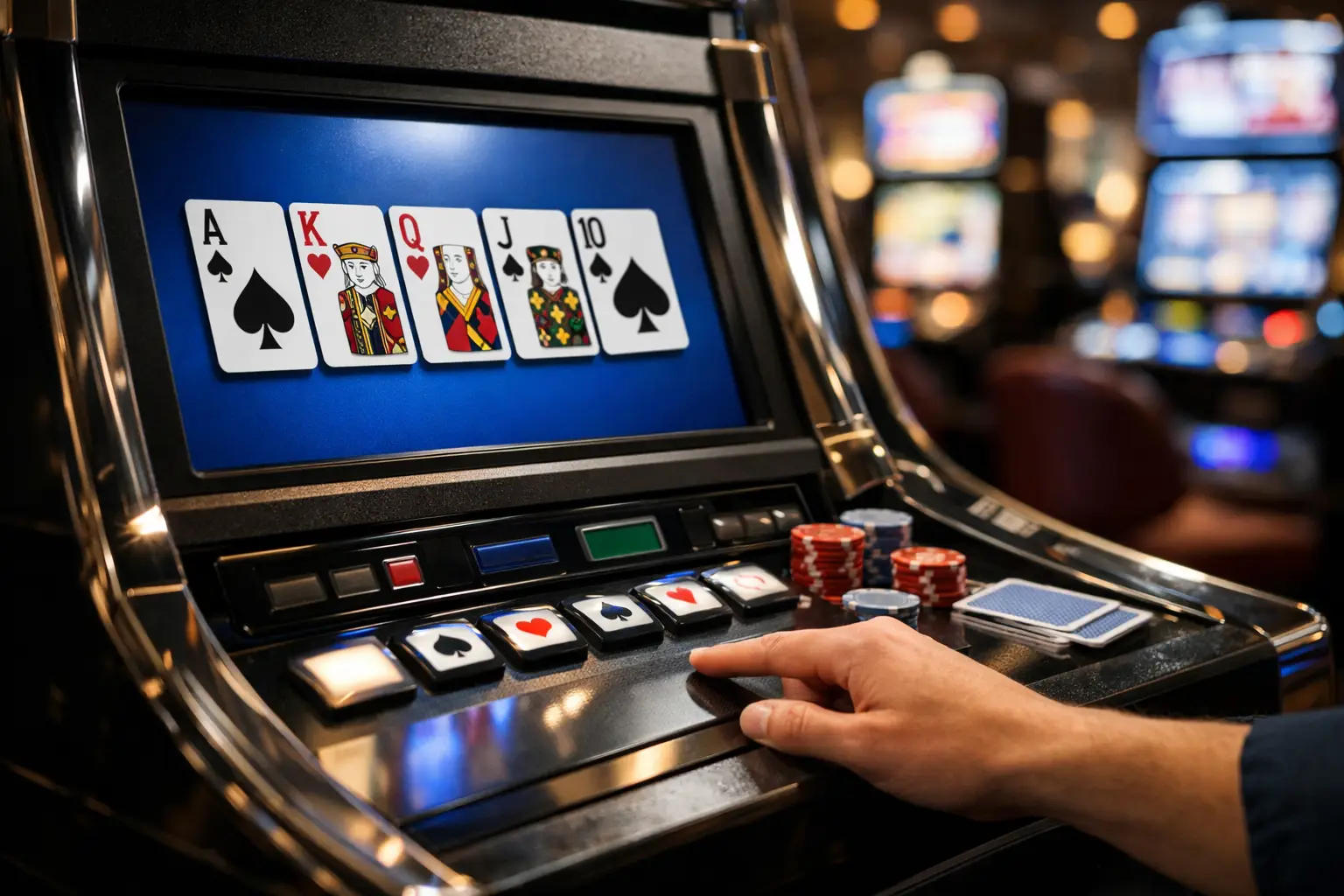
Sit down at a video poker cabinet, press Deal, and it feels simple. Five cards appear, you decide what to keep, and the machine tells you whether you won. But if you have ever wondered how do video poker machines work, the answer is actually a fun mix of real poker rules, computer logic, and carefully programmed payout tables.
That matters even more when you are shopping for a home machine. You want to know what the game is doing, what makes one setup feel authentic, and why a properly restored machine plays so much better than a mystery cabinet with an unknown history. Once you understand the basics, the whole experience makes a lot more sense.
How do video poker machines work behind the screen?
At the core, a video poker machine is a computer-driven game built to simulate a draw poker hand. Most commonly, that means a version of five-card draw. The machine deals you five cards from a virtual deck, you choose which cards to hold, and then it replaces the rest with new cards. Your final hand is checked against a pay table, and the machine awards credits if that hand qualifies.
What makes video poker different from a spinning reel slot is that your decisions matter. In a slot game, you hit the button and watch the result. In video poker, the first deal is only part of the hand. Your hold choices affect the final outcome, which is why experienced players pay close attention to strategy.
That said, the machine is not inventing cards on the fly to help or hurt you. In a properly functioning game, the cards are selected through software that mimics drawing from a standard 52-card deck, or sometimes 53 if a joker is part of the variation. The randomness comes from an internal random number generator, usually called an RNG.
The random number generator is the engine
The RNG is what keeps each hand unpredictable. It constantly cycles through number combinations, even when nobody is playing. The moment you press Deal, the game uses that instant to determine the cards you receive. When you press Draw, it does the same thing again to determine the replacement cards.
This is one point that confuses a lot of people. The machine does not store a hand waiting for you in advance, and it does not usually operate like a live dealer physically shuffling a deck in front of you. Instead, the software uses random outputs to represent card positions in a virtual deck.
For the player, the result feels just like draw poker. You still get five cards. You still hold or discard. You still build toward hands like two pair, three of a kind, a flush, or a full house. The difference is that the dealing process is digital.
How the deal-and-draw cycle works
A single round follows a pretty clean pattern. First, you place your wager in credits. Then you hit Deal and receive five cards. At that stage, the machine waits for your input. You choose which cards to hold, then press Draw. The machine replaces the unheld cards one time, and the final hand is scored.
If your hand matches a paying combination on the pay table, you win credits. If not, the round ends and you can start again.
The pay table is a bigger deal than many casual players realize. It tells you exactly what each winning hand pays for the number of credits wagered. One machine might pay more for a full house or flush than another version of the same game. That changes the return of the game over time, which is why seasoned players look at the pay table before they ever hit Deal.
Why the pay table matters so much
When people ask how do video poker machines work, they often focus on the cards and the randomness. But the pay table is just as important because it defines the reward structure.
Take Jacks or Better, one of the most common formats. In that game, a pair of jacks, queens, kings, or aces is usually the lowest paying hand. From there, the payouts rise through two pair, three of a kind, straight, flush, full house, four of a kind, straight flush, and royal flush.
If the pay table is more generous, the game returns more value over the long run. If it is tighter, the machine pays less often or pays less for certain hands. That does not mean the machine is malfunctioning. It means the game is configured differently.
For home buyers, this is one of the reasons machine history matters. A properly refurbished cabinet should have known software, a working button deck, a readable screen, and game settings that operate the way they are supposed to. You want the fun of the experience, not the frustration of chasing glitches.
Skill matters, but only to a point
One reason video poker has such a loyal following is that it sits in the middle ground between pure chance and pure skill. You cannot control the cards you are dealt, but you can make better or worse decisions on the draw.
For example, if you are dealt four cards to a flush and a low pair, the mathematically best choice depends on the game variation and pay table. Sometimes keeping the pair makes more sense. Sometimes chasing the flush has better value. That is where strategy comes in.
Still, strategy does not override randomness. You can make the right decision and still lose the hand. Over time, good decisions improve results. In the short run, anything can happen. That is part of what keeps the game exciting.
Different game versions change the rules
Not every video poker machine plays the same way. Jacks or Better is the classic starting point, but there are many other versions, including Bonus Poker, Double Bonus, Double Double Bonus, Deuces Wild, and Joker Poker.
Each version changes something important. Maybe four aces pay more. Maybe deuces become wild. Maybe the qualifying pair is different. Maybe the best strategy changes dramatically because the premium hands are weighted differently.
That is why two machines can look similar on the outside but feel very different once you start playing. For a home game room, that variety is part of the appeal. Some owners want the straightforward feel of traditional Jacks or Better. Others want a wilder pay structure and bigger swings.
What makes a real machine feel different at home
A genuine casino-style video poker cabinet is more than just software on a screen. The cabinet, monitor, bill acceptor area, buttons, sound package, and internal components all contribute to the experience. When those parts are worn out, dirty, outdated, or half-disabled from years of commercial use, the machine may still power on, but it will not feel right.
That is where restoration matters. A former casino machine usually needs more than a quick wipe-down before it belongs in a basement, garage, or game room. It often needs cleaning, parts testing, software checks, button inspection, display evaluation, and removal of casino-specific hardware that serves no purpose in a home.
A home-ready machine should be dependable and easy to live with. You should not need to become a technician just to enjoy a few hands after dinner. That is why a hands-on refurbishment process matters so much. At St. Louis Slots, that means each machine is gone through carefully so the fun part stays fun.
How do video poker machines work in a home setup?
For home entertainment use, the gameplay itself works the same way, but the machine is adapted for residential operation. Commercial casino machines were built for monitored gaming floors, not for family rooms and finished basements. That means they often include extra sensors, locks, and switching systems tied to casino accounting or security functions.
When a machine is properly prepared for home use, those unnecessary complications are removed or modified so the cabinet can operate more simply and reliably. The goal is not to change the game itself. The goal is to make ownership practical for someone who wants authentic casino-style entertainment without commercial headaches.
That difference is easy to overlook when you are shopping online. A machine may look complete in photos, but if it has not been thoroughly inspected, repaired, and updated, you may end up buying someone else’s problem. A good home machine should feel ready the minute it arrives.
The best way to think about video poker
Video poker works like digital draw poker with a built-in pay table and a random engine running underneath every hand. You make a wager, receive five cards, decide what to keep, draw replacements, and get paid if your final hand qualifies. The machine supplies the speed, sound, and casino feel. Your choices add the human element.
That combination is why people keep coming back to it. It is easy to learn, satisfying to play, and just strategic enough to stay interesting. And when the machine itself has been restored with care, it brings that same casino-style energy into your home without the smoke, the travel, or the guesswork.
If you are thinking about adding one to your space, the best starting point is simple: look for a machine that has been prepared to work as hard at home as it once did on the casino floor.
 | Check out our
Comments are closed