
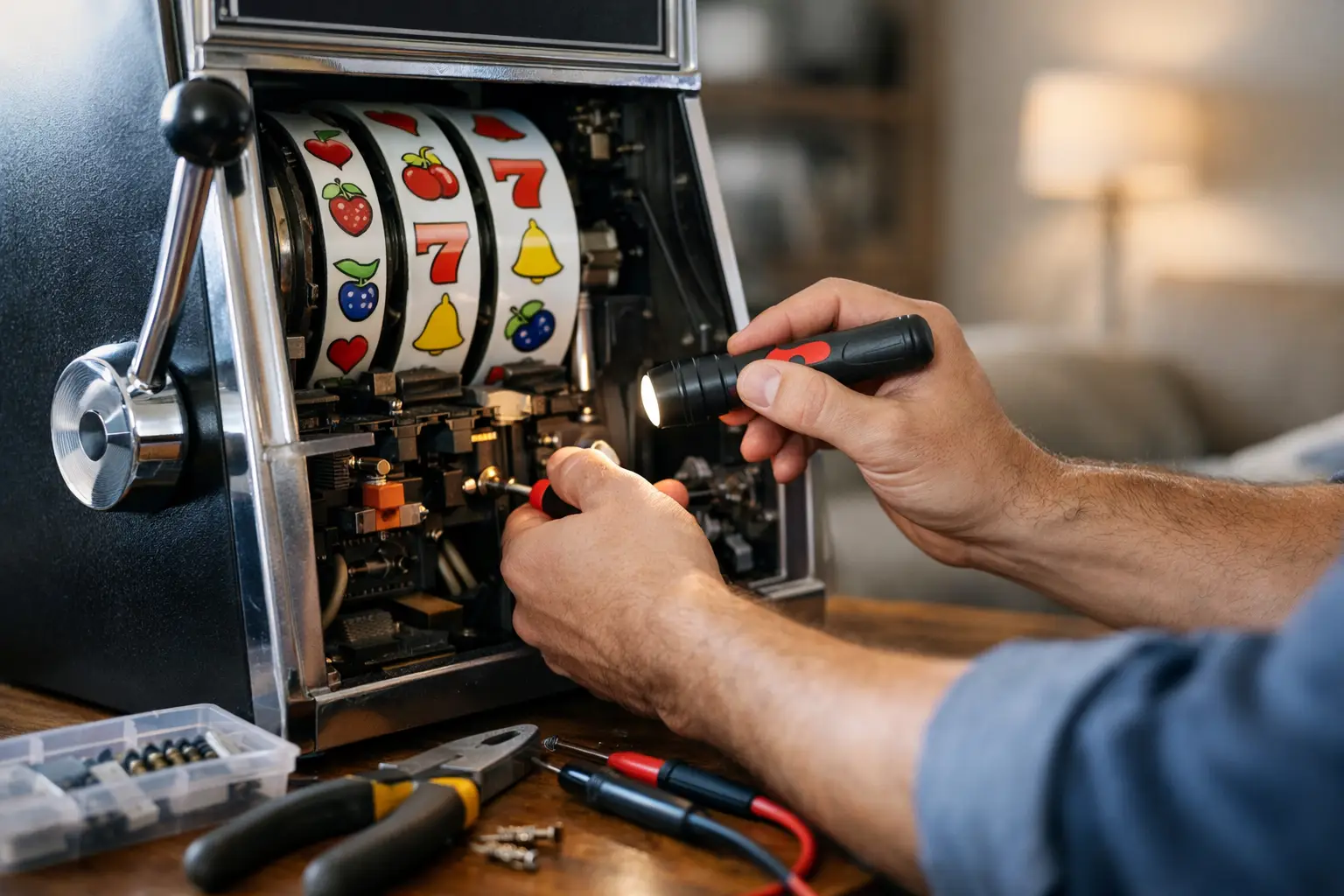
That moment when a slot machine powers on, lights up, and then refuses to spin is usually where home ownership gets very real. A lot of common slot machine repair issues are not dramatic failures. They are small, annoying problems that show up after years of casino use, storage, transport, or a rough conversion for home play.
If you are adding a real casino machine to a game room, basement, garage, or man cave, you want the fun part – the sounds, the nostalgia, the authentic cabinet, and that real button-and-reel feel. What you do not want is to spend your weekend tracing wires, guessing at error codes, or wondering why a machine worked yesterday and not today. That is why it helps to understand what tends to go wrong and what separates a properly refurbished machine from one that is only cleaned up on the outside.
The most common slot machine repair issues
Most home-use problems fall into a few categories. Power, buttons, bill acceptors, monitors, speakers, and communication errors are the usual suspects. The cause is not always a bad part. Sometimes it is a loose connection from moving the machine, old casino hardware that was never meant for residential use, or software settings that were not updated during refurbishment.
A former casino machine has lived a hard life. It may have run for years on a busy floor with constant play, regular service calls, and parts swapped in and out over time. Once that machine leaves the casino, it needs more than a wipe-down. It needs inspection, repair, testing, and in many cases modifications that make it practical for a home owner.
Power problems that look worse than they are
One of the most common complaints is simple: the machine will not turn on, or it turns on only partway. Sometimes the top box lights up but the screen stays dark. Sometimes the game boots and then shuts down. That can come from a failing power supply, a bad switch, a loose plug, or aging internal components that no longer hold steady voltage.
This is one of those areas where the difference between used and properly refurbished really matters. A machine may appear fine during a quick demo but fail later when heat builds up or a weak connection shifts during transport. Home owners usually do not need to become power experts, but they do need to know that these issues are common in older equipment.
Button and touchscreen failures
Buttons take a beating. Spin, bet, cash out, and service buttons are pressed thousands of times over the life of a machine. Eventually, they get sticky, intermittent, or completely dead. On touchscreen games, wear can show up as delayed response, poor calibration, or sections of the screen that stop registering input.
The good news is that these are often very fixable issues. The catch is that a button problem is not always the button itself. It can also be wiring, a board connection, or a configuration issue tied to the game. A machine that has been fully shopped and tested should have those weak points identified before it ever reaches your home.
Bill acceptor issues
For a lot of buyers, this is the first thing that raises concern. The machine turns on, the game looks great, but it will not take bills consistently. Bill acceptors are mechanical, electronic, and a little picky by nature. Dust, worn rollers, dirty sensors, old firmware, and improper setup can all cause feeding problems.
In a home environment, this issue can also come from expectation mismatch. Casino-grade bill validators were built for constant commercial operation, and some need proper cleaning and updates to behave well in residential use. If the machine was not prepared correctly, bill acceptance may be frustrating from the start. If it was refurbished and updated with care, it is much more likely to work the way a home owner expects.
Why older casino parts can create recurring problems
There is a big difference between a machine that is original and a machine that is ready for home use. Original casino machines often include sensors, locks, switches, and communication systems tied to a regulated casino floor. Those parts served a purpose in the casino, but they can create headaches in a house, especially if they are left in place even though they are no longer needed.
Unnecessary sensors and door-related errors
Casino machines are designed to detect door openings, cash box access, tilt conditions, and service events. In a casino, that makes sense. At home, those same systems can trigger nuisance errors if they are not removed, bypassed, or properly adjusted during conversion.
A machine might look broken when it is actually waiting for a condition that no longer applies in home use. That is one reason a casual seller may say a game is “working” while the buyer later finds themselves stuck with service lights, door errors, or startup warnings they do not understand.
Board and communication faults
Another one of the common slot machine repair issues involves board communication. The machine may boot into an error, freeze during startup, or fail to recognize a component. Sometimes that points to a real hardware fault. Other times it is a loose harness, corrosion on a connector, or outdated software.
This is where hands-on inspection matters. These machines are a mix of electronics, software, moving parts, and years of service history. You cannot reliably judge them by cabinet appearance alone. A sharp-looking machine can still hide intermittent board issues that only show up after repeated testing.
Monitors, sound, and cosmetic wear that affects performance
Home buyers often focus on the cabinet artwork and overall look first, which makes sense. But the play experience depends just as much on the monitor, speakers, and internal condition.
Dim screens and display failures
A monitor can be technically on and still be on its way out. Fading brightness, color distortion, flickering, or a long delay before the picture appears are all warning signs. Older screens may still function, but they are not always reliable enough for long-term enjoyment.
For some owners, a dim monitor is tolerable if the game is mostly decorative. For most people, though, poor display quality takes the fun out of the machine fast. If you are buying for regular home entertainment, monitor condition should be treated as a core mechanical issue, not just a cosmetic one.
Weak speakers and missing game audio
Slot machines are supposed to have personality. When the sound cuts out, crackles, or drops on one side, the game loses a lot of what makes it special. Speaker wear, amp issues, board faults, and simple wiring problems can all be behind weak or inconsistent audio.
This is also a good example of why a machine should be tested as a complete experience. Lights, reels, bill acceptor, button panel, sound, and game logic all need to work together. Fixing one issue while ignoring three others is not real refurbishment.
What home owners can check before calling for service
A few problems are worth checking before assuming the worst. If a machine was recently moved, verify the power cord is secure and any accessible plugs are seated firmly. Make sure doors are fully closed. If the bill acceptor is acting up, inspect for obvious dust or a bill jam. If a button is inconsistent, note whether the issue happens every time or only during certain game screens.
That said, there is a line between simple observation and getting in over your head. Former casino machines are specialized equipment. Guesswork can turn a small issue into a bigger one, especially if boards, settings, or wiring are involved. It is usually smarter to stop at basic checks and get help from someone who works on these machines regularly.
The real fix is often better preparation, not just repair
The best way to avoid common slot machine repair issues is not to become your own technician. It is to start with a machine that has already been cleaned, inspected, repaired, updated, and converted properly for home use.
That means looking beyond surface polish. Was the machine actually shopped? Were weak parts addressed? Was software updated? Were casino-only sensors and unnecessary switches removed or modified for residential operation? Was the game tested enough to catch intermittent faults instead of just proving it powers on once?
Those details matter because a home-use machine should feel easy to own. You should be able to enjoy it with friends, hear the sounds, feed in bills, hit the buttons, and trust it to do what it is supposed to do. A careful restoration process takes a lot of future headaches off the table.
At St. Louis Slots, that hands-on approach is exactly why refurbishment matters so much. When a machine is inspected point by point and prepared for real residential use, it is simply more fun to own.
If you are shopping for a slot machine for your home, the smartest question is not just whether it works today. Ask whether it has been prepared to keep working after the excitement of delivery day wears off.
 | Check out our
Comments are closed